
AKIPRESS.COM - 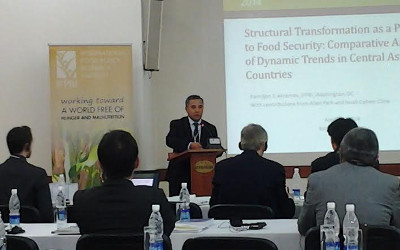 In recent years, the governments of Central Asian counties have placed great emphasis on agriculture and food security. Although the recent global food and economic crises had significant impacts on all countries in the region, soaring food prices and financial strain were particularly painful for poorer countries, such as Kyrgyzstan and Tajikistan, which depend highly on food imports and remittances, according to 2013 Global Food Policy Report presented by the International Food Policy Research Institute on April 8 in Bishkek.
Spiking food prices reduced the affordability of food, and downturns in the inflow of remittances from workers abroad further undermined the ability of these countries to finance food imports.
Thus, the Kazakhstan government adopted a multiyear agricultural development program targeting long-term efficiency and productivity improvements by stimulating adoption of efficient technologies and inputs, increasing investment in market and production infrastructure, and promoting land improvement. The program, Agribusiness 2020, prescribes a wide range of policy instruments aimed at boosting agricultural productivity and agribusiness competitiveness, including provision of concessional credit, investment grants, and input subsidies for agricultural producers; per-hectare payments to farmers for locally determined priority crops; a more favorable tax structure for agricultural enterprises; and a variety of credit and tax concessions to the food-processing sector. These policies are designed to balance agriculture’s share in output and employment, though not specifically to bolster domestic food security, which is less of a concern in Kazakhstan.
In Kyrgyzstan, where land fragmentation and farm productivity are pressing food-security issues, the government has been vigorously debating approaches to land consolidation, with discussions centering on measures to facilitate farmer cooperatives. Although no related policies have yet been enacted, the government did make policy progress in the area of agricultural trade, which it needs to expand in order to increase agricultural gross domestic product and to raise the purchasing power of agricultural households. In 2013, the government adopted a new National Export Strategy focused on promoting exports of fruits and vegetables, dairy products, and meat. The strategy also focuses on improving sanitary, phytosanitary, and other quality-control measures; increasing farmers’ access to finance; and promoting trade-facilitation measures. This strategy is expected to increase farmer incomes and improve the general well-being of rural households.
The government of Tajikistan, in turn, continued implementing a comprehensive Agrarian Reform Program, finalized in late 2012. This program addresses Tajikistan’s major domestic food-security challenge – farm productivity – by reducing government interference in farmers’ decision-making; increasing private incentives; and supporting access to rural finance, inputs, and advisory (extension) services. Some related key laws were also implemented. For example, a new farm law facilitated farm restructuring to enhance farmer incentives and decision-making. In addition, a new cooperative law created a legal basis for the development of farmer organizations and cooperatives to enable new individual and family farms to pool financial and capital resources. The government amended the land code to establish inheritable and exchangeable land-use rights for the first time and adopted an integrated water resources management approach that allows the establishment of local river basin organizations and water user associations to better manage hydrological resources. The government also piloted an effort to create local advisory and information centers staffed by agronomists to support farmers.
The government of Uzbekistan advanced its policy on land consolidation with provisions that set a minimum land area for cotton- and cereal-producing farms at 30 hectares and a limit for farms specializing in horticulture and other crops at 5 hectares. The new resolution allows both voluntary and government-driven acquisition methods for ensuring that plot sizes meet these requirements. The rationale for the relatively large land size requirements is unclear, and some argue that this intervention in the land market may undermine farmers’ perceptions of tenure security. With support from development partners, the government continued its policy on diversification of crop production toward nutritious and higher-value fruit and vegetable crops.
The essay was prepared by Kamiljon Akramov and Noah Cohen-Cline, Research Fellow and Senior Research Assistant at IFPRI's Development Strategy and Governance Division.