
AKIPRESS.COM - 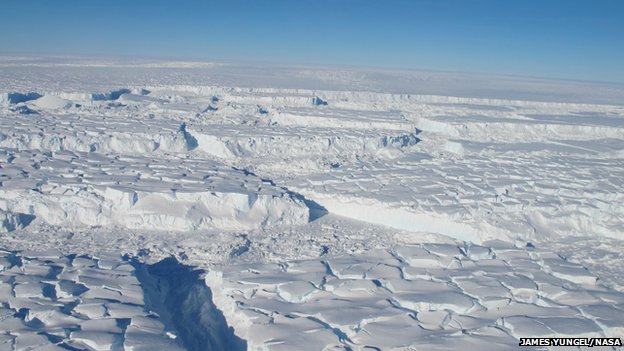 Key glaciers in West Antarctica are in an irreversible retreat, a study team led by the US Space Agency NASA says.
It analysed 40 years of observations of six big ice streams draining into the Amundsen Bay and concluded that nothing now can stop them melting away.
Although these are abrupt changes, the time-scales involved are likely measured in centuries, the researchers add.
If the glaciers really do disappear, they would add roughly 1.2m to global sea level rise.
The new study has been accepted for publication in Geophysical Research Letters, a journal of the American Geophysical Union, but Nasa held a teleconference on Monday to brief reporters on the findings, BBC reports Monday.
Prof Eric Rignot said warm ocean water was relentlessly eating away at the glaciers' fronts and that the geometry of the sea bed in the area meant that this erosion had now entered a runaway process.
"We present observational evidence that a large section of the West Antarctic Ice Sheet has gone into a state of irreversible retreat; it has passed the point of no return," the agency glaciologist explained."This retreat will have major consequences for sea level rise worldwide. It will raise sea levels by 1.2m, or 4ft, but its retreat will also influence adjacent sectors of the West Antarctic Ice Sheet which could triple this contribution to sea level."
The Amundsen Bay sector includes some of the biggest and fastest moving glaciers on Earth.
Pine Island Glacier (PIG), over which there has been intense research interest of late, covers about 160,000 sq km, or about two-thirds the area of the UK.
Like the Thwaites, Smith, Haynes, Pope, Smith and Kohler Glaciers in this region - the PIG has been thinning rapidly.
And its grounding line - the zone where the glacier enters the sea and lifts up and floats - has also reversed tens of km over recent decades.
What makes the group vulnerable is that their bulk actually sits below current sea level with the rock bed sloping inland towards the continent.
This is a geometry, say scientists, that invites further melting and further retreat.
The new study includes radar observations that map the underlying rock in the region, and this finds no ridge or significant elevation in topography that could act as a barrier to the glaciers' reverse.