
AKIPRESS.COM - 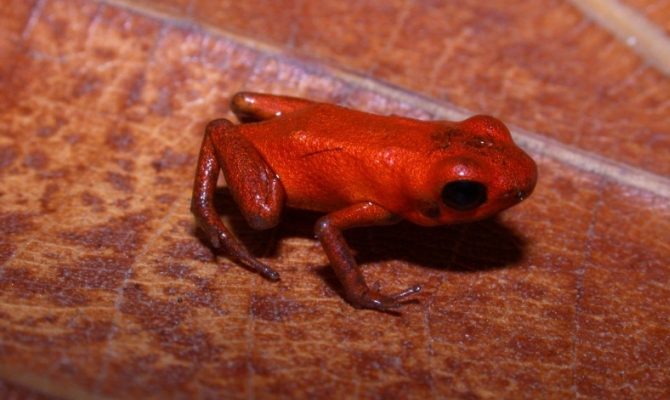 The frog that was hidden in the headwaters of the Rio Cano in Panama, grabbed the attention of the researchers for the first time when they heard the unique characteristic call, the Science World Report said.
The specimen was described by researchers at the Smithsonian Tropical Research Institute and the Universidad Autonoma de Chiriqui, Panama and Universidad de los Andes, Colombia.
The poison dart frog dubbed 'Andinobates geminisae' after Geminis Vargas - the wife of co-author Marcos Ponce - for her support. The species was initially collected in February 21, 2011 by field assistant Samuel Valdes. Apart from the specimens at headwaters of the Rio Cano, biologists Marcos Ponce and Abel Batista collected additional specimens between Rio Cocle del Norte and the Rio Belen. These specimens were later transferred to the University of Panama.
"Abel Batista and Marcos Ponce were the first to note the presence of this species," said Smithsonian herpetologist Cesar Jaramillo. "They've known it was there for several years. However, they were not sure if it was only a variety of another poison dart frog species, Oophaga pumilio, which exhibits tremendous color variation. Based on morphological characteristics of the adult and the tadpole, I thought it might be a new species of Andinobates."
It was only after Professor Andrew Crawford at the Universidad de Los Andes sequenced the DNA of the bright orange frog, the researchers confirmed that the new species was new poisonous dart frog called Andinobates. Further details on the frog's genetics are available at the Barcode of Life Data System and in GenBank.
Sadly, since this new frog species was collected from the small area, threats like habitat loss and gathering the species for pet trade cause a great harm to their existence. Due to this, the biologists recommend the formulation of special conservation plans to guarantee the survival of the species.
"A. geminisae is included in the captive breeding program of the Panama Amphibian Rescue and Conservation project, a consortium of six zoos and research institutions dedicated to saving amphibians from the chytrid fungal disease, which is decimating amphibians worldwide, and habitat loss," according to the news release.
The finding is published this week in Zootaxa.