
AKIPRESS.COM - 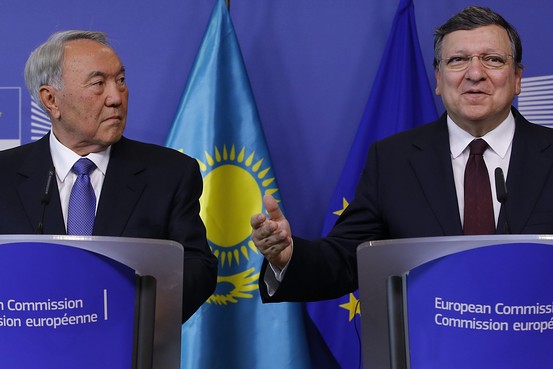 The European Union and Kazakhstan agreed Thursday on a new partnership and cooperation deal, a relatively modest pact that highlights the bloc’s scaled-down options regarding its eastern neighbors, reports WSJ.
The deal will bolster cooperation in areas from food safety to energy to fighting terrorism. But it won’t affect tariffs, and it falls far short of the wide-ranging “association agreement” between the EU and Ukraine that prompted a bitter standoff with Russia.
Kazakhstani government has adopted a Path to Europe program and at the same time it is joining a Russian-led economic union. EU officials have emphasized that the Kazakhstan deal wouldn’t affect its agreements with Russia nor its status within the economic union. That union is currently a customs agreement, but it is set to become a broader Eurasian Economic Union on January 1, 2015.
Kazakh President Nursultan Nazarbayev took the opportunity to criticize the penalties the EU and Russia have imposed on each other in the wake of the Ukraine crisis. “Sanctions, especially economic ones, are not helpful to anyone—neither Europe, nor Kazakhstan or Russia,” Mr. Nazarbayev said.
The agreement still must be formally adopted by both sides, and officials hope for a final signature some time next year. Beyond economic ties, the document outlines both sides’ commitment to promoting democratic institutions and the rule of law. Still, Mr. Nazarbayev, who has been Kazakhstan’s president for 24 years, was re-elected in 2011 with more than 95% support in a vote that was criticized by international monitors.
This is the first deal of this scope between the EU and a Central Asian country. It updates and expands a more limited EU-Kazakhstan agreement dating to 1999, and the renewal was driven partly by Kazakhstan’s hopes for joining the World Trade Organization.
Kazakhstan doesn’t border the EU, and it wasn’t part of the bloc’s “Eastern Partnership” initiative, which sought to craft far-reaching association agreements with six countries on Europe’s eastern flank.
That initiative had some success, but it ultimately faltered in the face of fierce Russian objections. The EU has now signed association deals with three countries—Georgia, Moldova and Ukraine—although the pact with Ukraine has been partially delayed in recognition of Russian concerns.
The EU-Kazakh agreement signals the more limited outreach that the bloc may now be forced to adopt with the countries to its east, given Moscow’s evident determination to keep many of these nations in its orbit. It focuses on increasing cooperation and personal contacts, rather than changing laws or dropping tariffs, in an attempt to lay the groundwork for deeper relations in the future.