
AKIPRESS.COM - 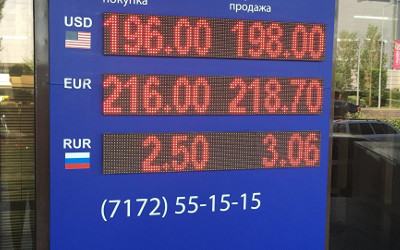 Kazakhstan's tenge rapidly neared the upper limit of its trading corridor on Wednesday, fuelling expectations of an imminent devaluation as the country's oil-dependent economy struggles to weather a sharp fall in crude prices.
The central Asian nation's central bank said in mid-July it would allow the tenge - which it devalued in February 2014 - to weaken on the market, extending the corridor's ceiling by 10 tenge to 198 per dollar, reports Reuters.
But since then pressure on the tenge has risen as oil prices have slipped below $50 and the rouble of its biggest trading partner Russia fallen around 15 percent.
Furthermore, neighbouring China devalued its yuan last week and on Wednesday another, smaller trading partner, Vietnam, devalued its dong.
The second-largest post-Soviet economy and the region's second-largest oil producer after Russia, Kazakhstan has also suffered under the impact of western sanctions against Russia and, as a metals exporter, from low commodities prices.
The tenge was fluctuating at 197.07-197.12 to the dollar on the interbank market on Wednesday, around 5 percent below its rate on Tuesday and rapidly approaching the trading band ceiling.
HalykFinance analyst Sabit Khakimzhanov predicted a sharp devaluation.
"A new level, at which the National Bank will defend the rate (if it has taken this decision), will be much higher," he wrote on his Facebook page. "We estimate a necessary devaluation at a level not lower than 230 per dollar."
In February 2014, when oil prices were also low, Kazakhstan devalued the tenge by 19 percent, helping to keep economic growth at a respectable 4.3 percent last year. The government expects growth to drop to 1.5 percent this year.
Earlier on Wednesday, the official rate of the tenge , which is set on Kazakhstan's Stock Exchange, weakened to 188.38 per dollar from 188.35.
Widening the currency corridor last month, National Bank Governor Kairat Kelimbetov said he was confident the central bank would be able to keep the tenge within the new trading band, if the oil price held at $55-60 per barrel.
But as of 0750 GMT on Wednesday, benchmark Brent crude traded at $48.94.
"The (oil) price is already $48 (per barrel), which means that the demand of a certain part of the business community for a sharp devaluation ... will be satisfied," said economist Olzhas Khudaibergenov.