
AKIPRESS.COM - 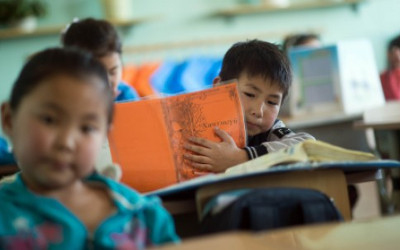 For more than 50 years, children on the windswept steppes of Mongolia have studied in a school built by a surprising benefactor: North Korea, reports South China Morning Post.
An image of the hermit state’s founder Kim Il-Sung hangs in a classroom in the yellow, two-storey building, symbolizing a time when the countries marched largely in lockstep as Communist cogs in the machinery of Cold War confrontation.
Former Soviet satellite Mongolia rode the wave of revolution that swept across Eastern Europe in 1989 and has become a vibrant democracy. North Korea, conversely, has doubled down into monolithic, nuclear-armed isolation.
But the ties of the past endure, as evidenced by continuing North Korean attention to the school – and a quiet diplomatic channel between Ulaanbaatar and Pyongyang.
The school has around 300 pupils aged 6 to 18, some of them boarders who stay in a dormitory while their nomadic parents herd sheep and other livestock on the steppes.
Deshigiin Chuluunbat, principal, says its 1961 construction had its origins in the Korean War of the previous decade, when Mongolia sent horses and food as aid to Pyongyang and also took in North Korean orphans.
“North Korea reciprocated that help and built this school,” he said at the facility in Altanbulag, Tov province.
Even now, North Korean visitors come every year, despite Pyongyang eschewing the democratic trends that Mongolia has embraced and managing an economy under international sanctions over its atomic and missile programs.
Pyongyang renovated a physics classroom in 2012 – the centenary of Kim’s birth – installing two plaques above the door emblazoned with his name in Korean and Mongolian, as well as his portrait over the blackboard.
“The ordinary people in the village are totally unaware of North Korea’s politics,” said Chuluunbat. “They don’t pay attention or have any interest in it. They just think it’s good to collaborate with them and have a great school from them.”
Mongolia’s government, however, acts as an intermediary in global efforts to engage with North Korea.
As part of what is known as the Ulaanbaatar Dialogue – the name uses official transliteration – Mongolia has hosted negotiations between diplomats from Tokyo and Pyongyang over the issue of Japanese kidnapped to North Korea to train its spies.
It saw a reunion in March last year between the parents of best known abductee Megumi Yokota – seized as a 13-year-old in 1977, and whose fate remains unclear – and her North Korea-born daughter.
“Mongolia is uniquely positioned as the only country in Northeast Asia that enjoys good relations not only with North Korea but also South Korea, the United States, China, Russia and Japan,” Brookings Institution scholars wrote in a paper.
A sprawling, sparsely-populated country squeezed between giant neighbours Russia and China, Mongolia lies in a wider East Asian region beset by territorial squabbles and resentments from modern history, notably the second world war.
“Mongolia wants to be a new Helsinki, a new Geneva,” said the senior research fellow at the Institute of International Affairs of the Mongolian Academy of Sciences.
The Finnish capital was a venue for easing Cold War tensions via the landmark Helsinki Accords, and the Swiss city has for decades served as a key international negotiating centre.
Even so Mongolia has not shied from blunt speaking.
President Tsakhiagiin Elbegdorj, who as a student leader played a key role in the country’s democratic transition, visited North Korea in 2013 and extolled the benefits of freedom at Pyongyang’s Kim Il Sung University, saying in a speech: “No tyranny lasts forever.”