
AKIPRESS.COM - 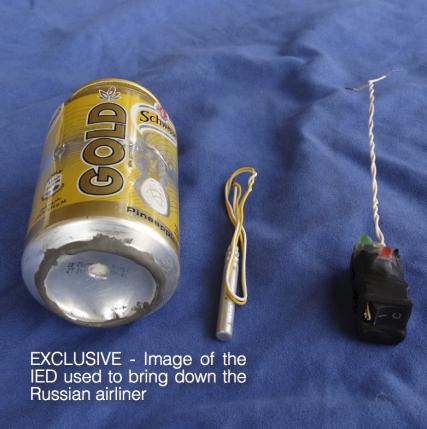 Islamic State's official magazine carried a photo on Wednesday of a Schweppes soft drink can it said was used to make an improvised bomb that brought down a Russian airliner over Egypt's Sinai Peninsula last month, killing all 224 people on board, reports Reuters.
The photo showed a can of Schweppes Gold soft drink and what appeared to be a detonator and switch on a blue background, three simple components that if genuine are likely to cause concern for airline safety officials worldwide.
"The divided Crusaders of the East and West thought themselves safe in their jets as they cowardly bombarded the Muslims of the Caliphate," the English language Dabiq magazine said in reference to Russia and the West. "And so revenge was exacted upon those who felt safe in the cockpits."
Western governments have said the Airbus A321 operated by Metrojet was likely brought down by a bomb and Moscow confirmed on Tuesday it had reached the same conclusion, but the Egyptian government said it has still not found evidence of criminal action.
Explosives experts said it was feasible the device shown in the photo could bring down a plane, depending on where it was located and the density of explosives in the soft drink can. The most vulnerable locations include the fuel line, the cockpit or anywhere close to the fuselage skin.
"The placement is the critical thing," said Jimmie Oxley, a professor of chemistry who specializes in explosives at the University of Rhode Island.
Oxley and other experts drew parallels with the bombing of Pan Am Flight 103 by Libyan nationals over the Scottish town of Lockerbie in 1988. An investigation showed a palm-sized explosive in a cassette recorder in a bag in the luggage hold had ripped a 50 centimeter hole in the fuselage and decompression caused the plane to break up in mid-air.
The apparent similarities, the detonator and switch suggested the soda can device was on a timer, rather than operated by a suicide bomber, suggested a similar chain of events on the Russian airliner, some experts said.
However, Clive Williams, a professor at the Australian National University's Centre for Military and Security Law and a member of the International Association of Bomb Technicians and Investigators, said the use of a soda can raised questions about whether the device was included in the catering supply.
Experts added that the photo could also provide a key clue in tracking Islamic State as the detonator pictured was a commercial one, which could be traced back to its manufacturer.