
AKIPRESS.COM - Kyrgyzstan has been ranked as number 95 in the world on how effectively children can use the courts to defend their rights according to new research from Child Rights International Network (CRIN).
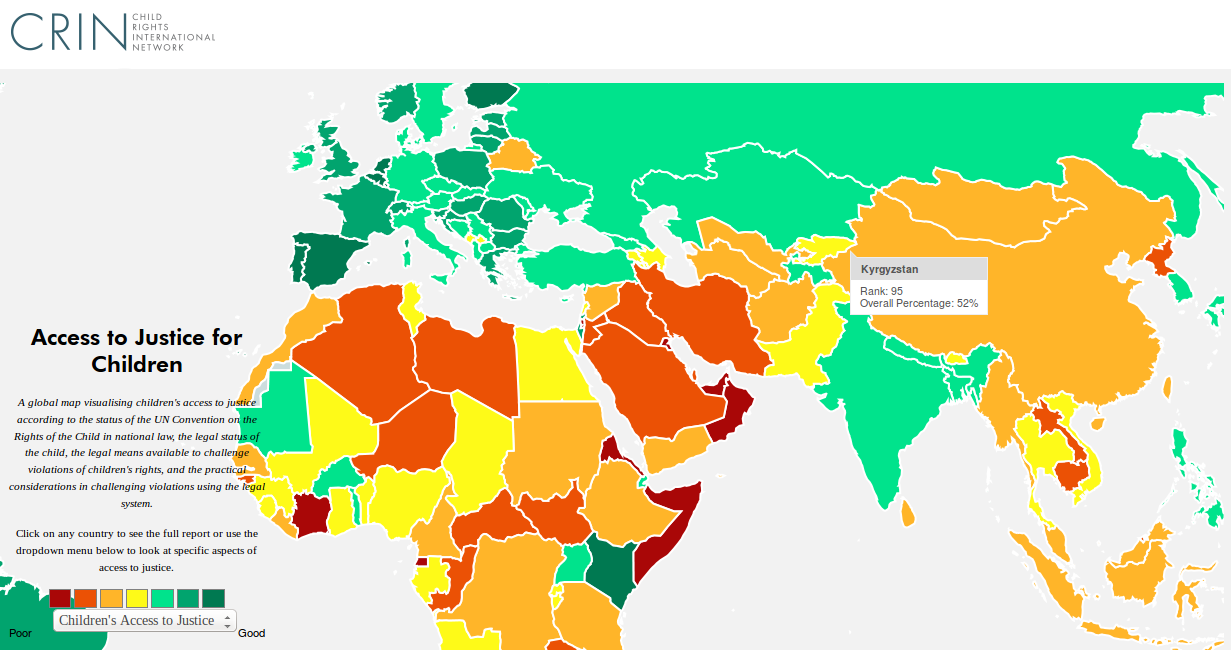
The new report, "Rights, Remedies and Representation", takes into account whether children can bring lawsuits when their rights are violated, the legal resources available to them, the practical considerations for taking legal action and whether international law on children’s rights is applied in national courts.
Kyrgyzstan ratified the UN Convention on the Rights of the Child (CRC) in 1994. The CRC can be directly enforced in national courts and takes precedence over national law. Full legal capacity is obtained at the age of 18, though children aged 16 or over may obtain full legal capacity if they enter labor relations or becomes an entrepreneur. In civil and administrative proceedings, the rights and interests of children who have not attained full legal capacity must be protected through their parents or legal guardians. The right to legal aid is explicitly set out in the Constitution of Kyrgyzstan and children are entitled to legal aid without means-testing. While legislation in Kyrgyzstan provides for specialized children’s courts these have not yet been created and reports suggest that law enforcement agencies must do more to investigate, prosecute, and punish perpetrators of violence against children.
Achieving access to justice for children is a work in progress and the report represents a snapshot of the ways children’s rights are protected across the world. The report condenses findings from 197 country reports, researched with the support of hundreds of lawyers and NGOs and is intended to help countries improve access to justice for children nationally.
Director of CRIN, Veronica Yates, said: “While the report highlights many examples of systems poorly suited to protecting children’s rights there are also plenty of people using the courts to effectively advance children’s rights.
“Our ranking represents how well States allow children access to justice rather than how well their rights are enshrined. However, it is hard to ignore how many countries with deplorable human rights records are on the lower end of the ranking for children’s access to justice.”
In the foreword of the report the chairperson of the UN Committee on the Rights of the Child Benyam Dawit Mezmur said: “The Committee welcomes this research and already envisages its concrete contribution to its various engagements with State Parties.
“Child rights standards in international instruments do not mean much for the lived reality of children if they are not implemented. In particular, if the fundamental rights of children are violated, it is critical that children or those acting on their behalf have the recourse, both in law and in practice, to obtain a remedy to cease, prohibit and/or compensate for the violation.
“I hope this study is only the beginning of a new shift in making access to justice for children a priority that will enable other rights to be fulfilled.”