
AKIPRESS.COM - 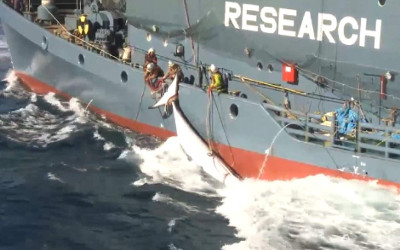 A fleet of four ships returned to Japan on Thursday after killing 333 whales in the Antarctic as part of the country's controversial hunt, according to The Washington Post.
The quota of 333 is a third of what Japan used to haul in on average every year. Now, it's the maximum number of kills allowed under the program, which Japanese officials say is all done in the name of science.
But not everyone agrees, including the United Nations International Court of Justice. In 2014, the court ordered Japan to halt the program after concluding that research claims couldn't justify the number of kills.
Japan temporarily stopped the hunt and proposed a new plan – 4,000 whales killed over 12 years. The International Whaling Commission asked Japan to revise the plan again, but the Asian nation went ahead and resumed the controversial hunt in late 2015.
The fleet spent four months in the Antarctic, killing 333 minke whales, 207 of which were pregnant.
"The number of pregnant females is consistent with previous hunts, indicating that the breeding situation of minke whales in the Antarctic is healthy," the Japanese Fisheries Agency said in a statement.
The Fisheries Agency said it also conducted non-lethal research. "Attaching GPS devices helps us study minke whales' migration routes by tracking them for several days," agency official Hiroyuki Morita said.
Conservationists say labeling the hunt as scientific is a way to skirt international rules; the International Whale Commission allows for scientific exemptions from its 1986 commercial whaling ban.
Australia is among the most vocal critics of the hunt; it brought the International Court of Justice case against Japan.
"We do not accept in any way, shape or form the concept of killing whales for so-called 'scientific research'," Australian environment minister Greg Hunt said in a statement last year.
He added: "There is no need to kill whales in the name of research. Nonlethal research techniques are the most effective and efficient method of studying all cetaceans."
Many of the whales end up as meals, as the surplus is sold off.