
AKIPRESS.COM - 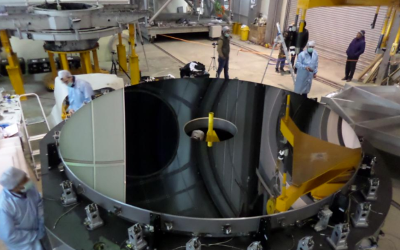 The Aries telescope has been a joint international effort between Indian, Russian and Belgian scientist. In March 2007 Aries and Belgian company Advanced Mechanical and Optical Systems (AMOS) entered a contract for design, manufacture, integration, testing, supply and installation of the telescope, reports DNA.
In a major technological advancement for astronomy in the country, Asia's largest and first of its kind optical telescope was unveiled on Wednesday evening at Devasthal near Nainital. During his one-day visit to Belgium, Prime Minister Narendra Modi remotely activated the Aryabhatta Research Institute for Observational Sciences (Aries) telescope along with Belgium Prime Minister Charles Michel.
The optical telescope's mirror has a 3.6 m diameter and it will further research of star structures and magnetic field structures of stars. The Aries telescope has been a joint international effort between Indian, Russian and Belgian scientist. In March 2007 Aries and Belgian company Advanced Mechanical and Optical Systems(AMOS) entered a contract for design, manufacture, integration, testing, supply and installation of the telescope. The total cost is estimated to be more than Rs 1200 million.
"This is a big thing because it is a product of Indo-Belgian collaboration. India has collaborated with a Belgian company called AMOS to produce this infrared steerable optical telescope which is the first of its kind in the whole of Asia," said Vikas Swarup, Ministry of External Affairs spokesperson. "The activation of this telescope is a major achievement for us and astronomers of the country. The project was challenging and the international collaboration helped us," said Wahab Uddin, acting director, Aries. He added, "The telescope is located at a height of 2,500 metres and the site was chosen for getting a clear view of the sky."
Currently, the Vainu Bappu observatory in Kavalur, Tamil Nadu is home to Asia's largest optical telescope. "The telescope at Devasthal will provide us with a great tool to advance our astronomy research. Indian astronomers have long felt the need to go beyond the 2 metre reflector size and the ARIES project has been long in the making. Scientists first thought about going for a larger telescope in the early 1990's," said Arvind Paranjype, director, Nehru Planetarium, Mumbai.