
AKIPRESS.COM - 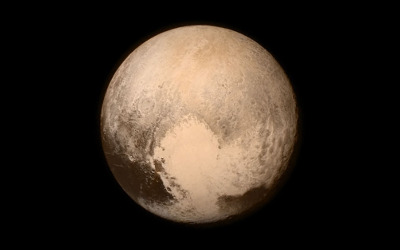 The debate continues over the status of Pluto, erstwhile ninth planet in Solar System, as scientists begin to dig into the data sent by NASA probe New Horizons as it flew by Pluto in July of last year, says Cantech Letter.
“These results speak to the power of exploration. Once again we’ve gone to a new kind of place and found ourselves discovering entirely new kinds of expressions in nature,” says Alan Stern, New Horizons’ principal investigator.
In a study published in the Journal of Geophysical Research – Space Physics, researchers led by David J. McComas, professor of astrophysical sciences at Princeton University, were able to do something that before New Horizons was impossible: analyze direct measurements of Pluto’s interactions with the solar wind – that continuous stream of charged particles emitted from the sun and traveling out into the void at speeds of 160 million kilometers an hour.
The researchers found that much like when it meets up with other planets in its path, the solar wind coming upon Pluto runs into the heavy ions of its atmosphere. Yet, unlike its interaction with other planets, as the solar wind moves around and past Pluto, it forms an ionic gas tail similar to that formed behind comets.
“Thus, we find that Pluto’s interaction with the solar wind is a hybrid of comet-like and the Venus/Mars-like interactions,” say the study’s authors.
All of this new information is available thanks to the Solar Wind Around Pluto (SWAP) instrument that was installed on New Horizons and in the end functioned perfectly as the spacecraft passed by Pluto, reaching a distance of roughly 12,000 km from the planet’s surface.
“The SWAP instrument was specifically designed to measure the effects of the Pluto environment on the solar wind by viewing the sunward direction over a large fraction of the time through the flyby,” say the study’s authors.
So, how now to characterize Pluto? We’ve gone from thinking it to be a planet orbiting the Sun just like the rest of us, to downgrading it to a mere object crashing about the Kuiper belt along with the other rocks, asteroids and detritus, to raising it once again to planet status – albeit dwarf planet – status.
By the International Astronomical Union (IAU) categorization, established in 2006, for something to be a planet it must orbit around the Sun, have sufficient mass to be shaped by its own gravity and have “cleared the neighborhood” around its orbit. It turns out the Pluto hasn’t been able to push its weight around town (it’s only 2,300 km wide which is about the size of the Earth’s moon) and clear the path of its orbit of other objects, as other planets do. Hence the dwarf status.